


Babywearing: not just for babies

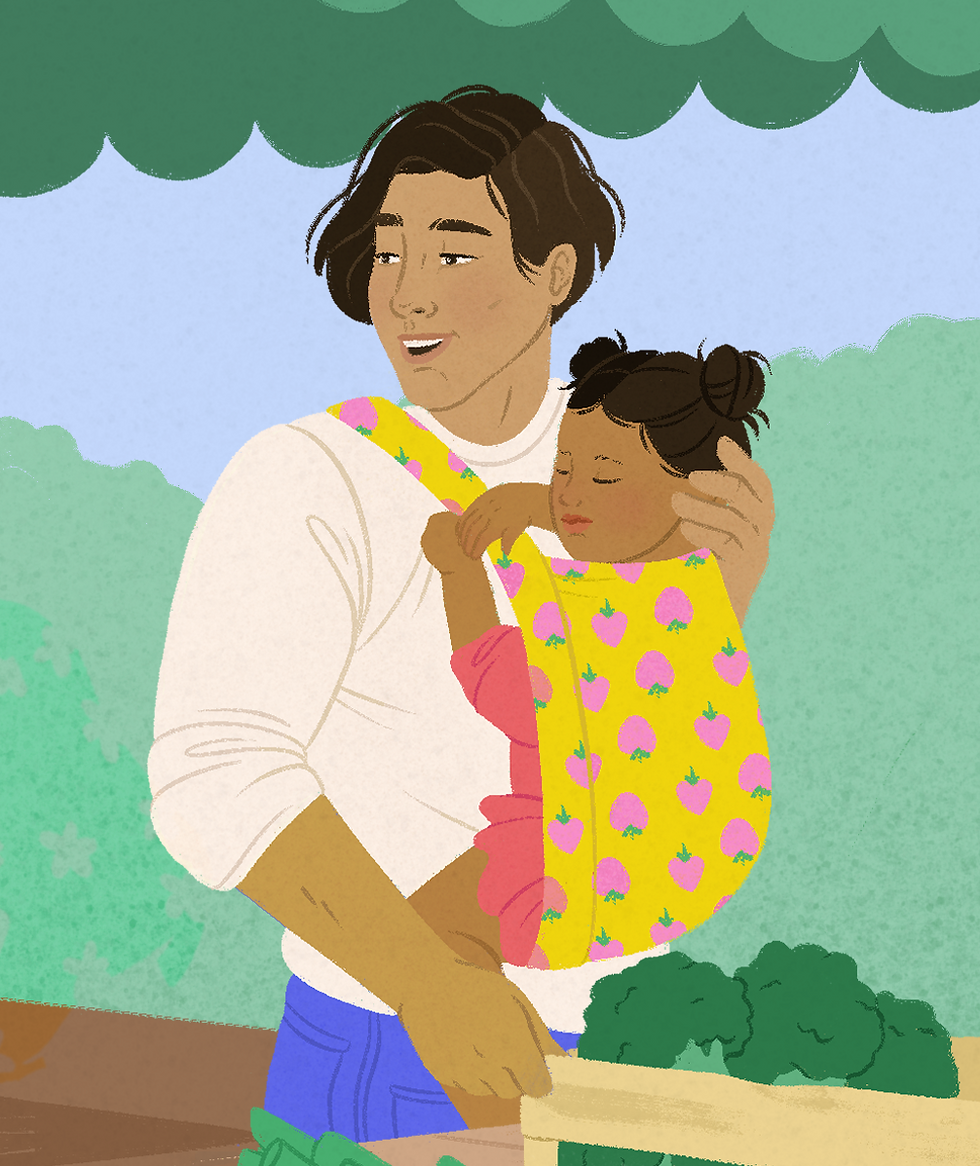
This article was first published in the Natural Parent Magazine, Issue 60, 2025. This beautiful artwork of a babywearing father and child is by Ellie Foster - and here with permission.
The way we describe the carrying of our children in a sling differs across languages. In English we call it babywearing, as if the benefits of carrying our children stop once they reach toddlerhood and beyond. Of course, the benefits of holding our children close continue well into pre-school years, even if our ability to easily carry them diminishes as they grow.
Holding our children close teaches them from infants that our bodies are a safe space, a sanctuary from the demands of the outside world. Using a carrier can help to facilitate this closeness in our busy lives. Our children’s reliance upon us does not cease once they are able to walk independently. Indeed, the circle of security model outlines their ongoing need for us to provide a place of safety. Children need caregivers to be a safe space for them to return to once their worldly adventures are enough (1).
The benefits of extended babywearing for both carer and child can be significant once our children pass infancy. In this time of childhood, there can be increasing periods of family separation as caregivers return to work, and children attend childcare or begin early childhood education. Babywearing can be a fabulous tool to help families come together after these times apart, bringing calm and connection to both caregiver and child.
Which carrier suits older children?
There are several options for carrying older children. Woven wraps are the most versatile carriers and may have no weight limit, meaning you could (in theory) carry an adult. The trick is having the skills to safely don and doff the wrap in a style to suit the caregiver and the child. Ring slings can be easily adjusted to accommodate taller and heavier children, with many brands recommending use for up to 20kg. Many of the more structured carriers come in toddler and pre-schooler sizes, with additional adjustments available for length and height, with some brands offering a 30kg safety rating.
It can be overwhelming making a choice that is right for you and your family. You might like to reach out to other babywearing families, a babywearing meet, a babywearing consultant, or even a health professional trained in babywearing if you have additional needs for consideration.
All good things must come to an end
Naturally, sooner or later our children grow up and our babywearing days come to an end. So how do we continue to hold our older kids close?
Once the little voice stops singing out “carry me?!” or “cuddle!”, what does it sound like for our children to reach out to us? Perhaps it depends on the time of day or how your week is tracking. You might hear the little voice sing out a variety of things. Maybe you hear: “play with me!”; “sit with me?”; “read to me!”; “hang with me?”; “lie with me!”; “stay with me?”; “tickle my arm?”; “tickle my back!”; “come closer to me”; “help me!”; “can you please tie my shoelaces”; or (joy of joys) “can you please wipe my bottom?”
The proximity and connection the little voice seeks can be found in different ways once the carrier is outgrown. It might look like playing games; sitting on the couch; holding hands; gentle strokes or pats on backs; piggy backs; lying down together at sleep time; reading books together. Perhaps your family has other things that work for you.
Older children may ask for help doing tasks they have already mastered, such as tying shoelaces, dressing, or feeding. This can be frustrating for busy caregivers, and these requests may be seen as lazy or manipulative. Rather than viewing the child as incapable, it can help to change the lens to one seeking connection. A child’s need for closeness does not dissipate once they become too big for “carry me”. Asking for help with these activities draws a caregiver near and can reproduce the closeness of being in the carrier, where your voice, breath, heartbeat, touches, and warmth create a soothing, safe place.
Children long to be close to their special people, to top up their emotional tanks. Children thrive when held close, allowing them to feel secure and loved, which promotes their growth and development. The benefits are two-way – holding your child supports the wellbeing of you both. Being close to others is a human requirement, our neurobiology needs it. Our emotional, physical and mental health relies upon a foundation of physical human connection, which then continues through life (2).
Hold your child close for life
All too soon our children are grown and flown, the season of their physical dependence on us as caregivers is past. We can set them up for a lifetime, by meeting their needs and establishing secure attachment in their early childhood. As John Bowlby, the renowned attachment theorist describes (1, 3):
“Intimate attachments to other human beings are the hub around which a person's life revolves, not only as an infant or a toddler or a schoolchild but throughout adolescence and years of maturity as well, and on into old age. From these intimate attachments a person draws strength and enjoyment of life and, through what he contributes, gives strength and enjoyment to others. These are matters about which current science and traditional wisdom are at one."
As our world increasingly seems to disconnect us, tools like babywearing can help parents strengthen connection in their families, from infancy, into toddlerhood, well into the preschool years, and beyond.
Kato x
References
1. Circle of Security International 2026 https://www.circleofsecurityinternational.com/circle-of-security-model/what-is-the-circle-of-security/
2. Zimmerman et al 2023, ‘ABM Clinical Protocol #37: Physiological Infant Care – Managing Nighttime Breastfeeding in Young Infants’, https://abm.memberclicks.net/assets/DOCUMENTS/PROTOCOLS/Physiologic%20Infant%20Care%20Protocol%2037.pdf
3. Bowlby, J. (1980) Attachment and Loss: Volume 1. Attachment. Basic Books: New York.


Comments